
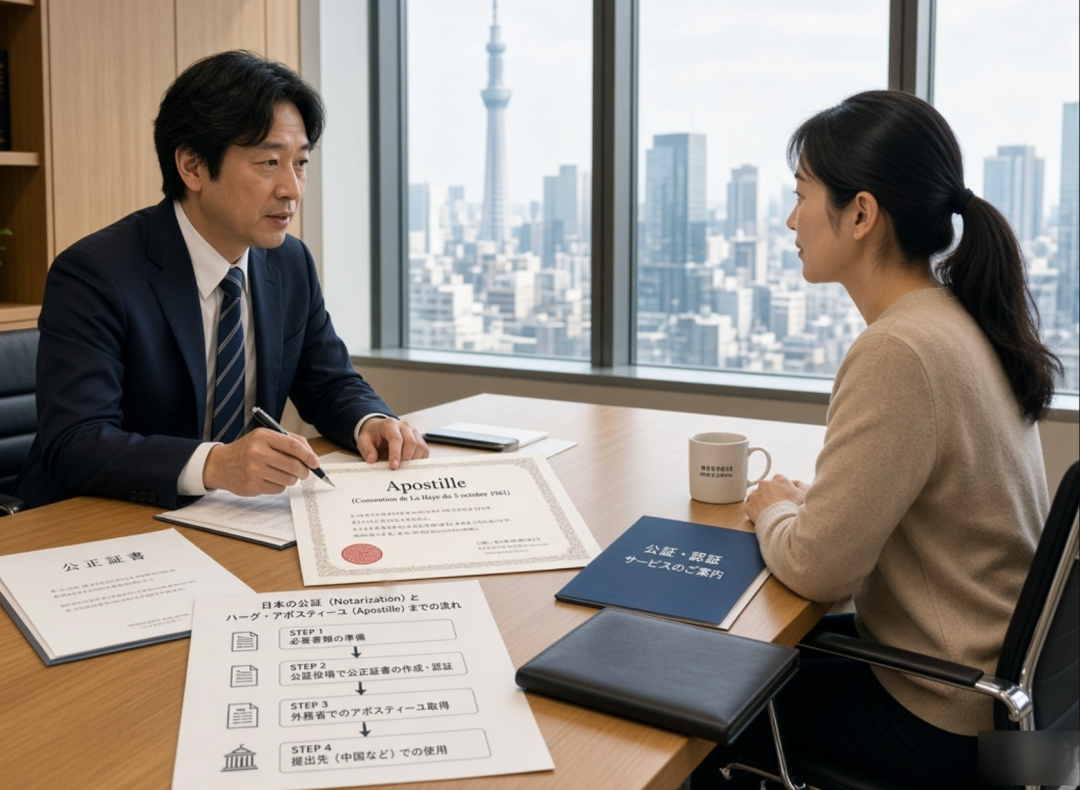
Japan: Comprehensive FAQ on Criminal Record Checks, Academic Certificates, and Power of Attorney – Apostille
📋 Most Comprehensive FAQ for 2026
Japanese Criminal Record Check, Academic Credentials, and Power of Attorney
Hague Apostille: The Complete FAQ
🎯 Study Abroad · Immigration · Business: Universal Guide
Gongshitong | Global Notarization & Authentication
In study abroad, immigration, employment, and business dealings, the three most frequently apostilled documents from Japan are criminal record certificates, academic transcripts, and powers of attorney.
Many people get stuck on questions like: "Should I notarize first?", "Can I apply directly?", "How do I proceed if I'm in China?", and "How long is it valid?" Today, we'll clear up the key points for handling these three types of documents using our most comprehensive FAQ, tailored to the latest rules for 2026.
I. General Basics
Q1After China joined the Hague Apostille Convention, do these three types of Japanese documents still require consular legalization for use in China?
A: No.Starting from 2023/11/7, qualified public documents between China and Japan will require only an Apostille issued by the Japanese Ministry of Foreign Affairs; consular legalization by Chinese embassies and consulates in Japan has been discontinued.
Q2What is the relationship between an Apostille and notarization?
A:Private documents must first be authenticated by a Japanese notary public to become "public documents" before they can undergo the Hague Apostille. Most public documents are eligible for direct application of the Ministry of Foreign Affairs Apostille.
Q3Is one-stop service available?
Yes.Notarization offices in Tokyo, Kanagawa, Osaka, Aichi, Fukuoka, Shizuoka, Miyagi, and Hokkaido (Sapporo Legal Affairs Bureau jurisdiction) offer the fastest service by completing notary certification, legal affairs bureau authentication, and Hague apostille in a single step.
Q4Can this be done while I'm in China?
Yes.Submit by mail, have a trusted friend or relative in Japan handle it on your behalf, or use a legitimate agency. However, original documents are typically required, and the power of attorney must comply with Japanese standards.
Q5Does the Hague Apostille have an expiration date?
A:Certifications have no fixed validity period, but the requesting party often requires a recent issuance (within 3–6 months). Additionally, the original document may itself have an expiration date, which is particularly evident for criminal record checks.
II. Japan Criminal Record Check (Criminal History Certificate) Apostille FAQ
Q6Is a certificate of no criminal record considered a public document or a private document?
A:A formal criminal record certificate issued by Japanese law enforcement agencies is an official document and, in principle, can be submitted directly to the Ministry of Foreign Affairs for Apostille certification.
Q7What is the process?
Apply at the police station of your last place of residence or the prefectural police headquarters. In-person application is available for those in Japan; for those abroad, apply via embassy/consulate or through an agent.
Obtain the original sealed document, then submit it directly or via an agent to the Ministry of Foreign Affairs for Apostille processing.
Note:Tampering may void the seal.
Q8Is notarization required?
A:Usually not required if issued by official police. May be needed for other forms of certification or translated copies.
Q9Validity and Important Notes?
A:Many countries and institutions require documents to be issued within 3–6 months. Please confirm the specific issuance date requirements with the requesting party before applying. Keep the document sealed until authentication is complete.
III. Japan Degree Attestation Hague Apostille FAQ
Q0Are public and private university degrees equivalent?
A: It's different.
Diplomas, transcripts, and other documents issued by national or public universities can typically be submitted directly for an Apostille as official documents.
Certificates issued by private universities are typically treated as private documents. They must first be authenticated by a notary public at the Notary Public Office, followed by an Apostille certification.
Q1What are the common documents required for academic credential verification?
A:Diplomas, degree certificates, transcripts, enrollment verification, graduation certificates, etc. When translations are required, notarized declarations may also be needed.
Q2Are there any special requirements for processing?
Documents must include the school's official seal and issuance details.
The Ministry of Foreign Affairs generally requires an issuance period within 3 months (negotiable in certain cases).
When targeting China, consider whether a Chinese-Japanese or Chinese-English bilingual version is needed.
Q3What if my transcript is lost or the school is uncooperative?
A:You may try to request a re-issuance from your school, or have a notary certify that the copy matches the original before proceeding with the Apostille process. For complex cases, professional assistance is recommended.
IV. Power of Attorney (Letter of Authorization) Hague Apostille FAQ
Q4Why must a power of attorney be notarized first?
A:A power of attorney is a typical private document. The Japanese Ministry of Foreign Affairs does not issue Apostilles directly for private documents. First, the signature must be authenticated by a notary public, then certified by the Legal Affairs Bureau before applying for Hague authentication.
Q5What is the standard process?
Prepare the power of attorney (recommended format: mutually accepted by the recipient, in Chinese-Japanese or Chinese-English bilingual).
Visit the Notary Office in person or through an agent to authenticate your signature (authentication in front of the notary is most secure).
Notary Public Certification (One-Stop Consolidation Available).
Ministry of Foreign Affairs Hague Apostille.
Q6What are the most common use cases for a power of attorney?
A:Study abroad application agency, immigration document submission, company registration/changes, real estate transactions, litigation representation, bank account opening, and more. Particularly common in business scenarios.
Q7Must the signature be made in person?
A:In most cases, the notary requires the signer to appear in person for notarization. In some situations, an agent may be accepted, but you must confirm the specific requirements of the notary office in advance and prepare sufficient supporting documentation.
5. Processing Times and Practical Tips (2026 Reference)
Time ReferenceOne-stop: fastest in 1–3 business days; Standard split + shipping takes approximately 1–3 weeks.
🎯 General Pitfall Warning:
Confirm specific requirements and formats with the document recipient (e.g., school, immigration authority, company, court).
The release timeline is tight. Start as soon as possible.
Ensure that copies are handled properly alongside the original documents.
Choosing an all-in-one service significantly reduces error rates.
Official information is subject to the latest announcements from the Japanese Ministry of Foreign Affairs and the Notaries Association.
📌 Key Takeaways
While background checks, academic credentials, and powers of attorney differ in type, they share the same core logic:Distinguish between public and private documents, follow the correct notarization-then-authentication sequence, leverage our one-stop service, and confirm recipient requirements in advance.。
Save this FAQ for reference to streamline your application process. Whether you're pursuing study abroad, immigration, or business purposes, following the correct procedures ensures your documents are processed smoothly. When you're ready to begin, review your specific document checklist first to decide whether to handle it yourself or hire a professional service.
🚀 Save · Compare · Pass on First Try
❤️ Save · Share · Hague Apostille FAQ ❤️
— Compiled from public information available in 2026 for reference only —