
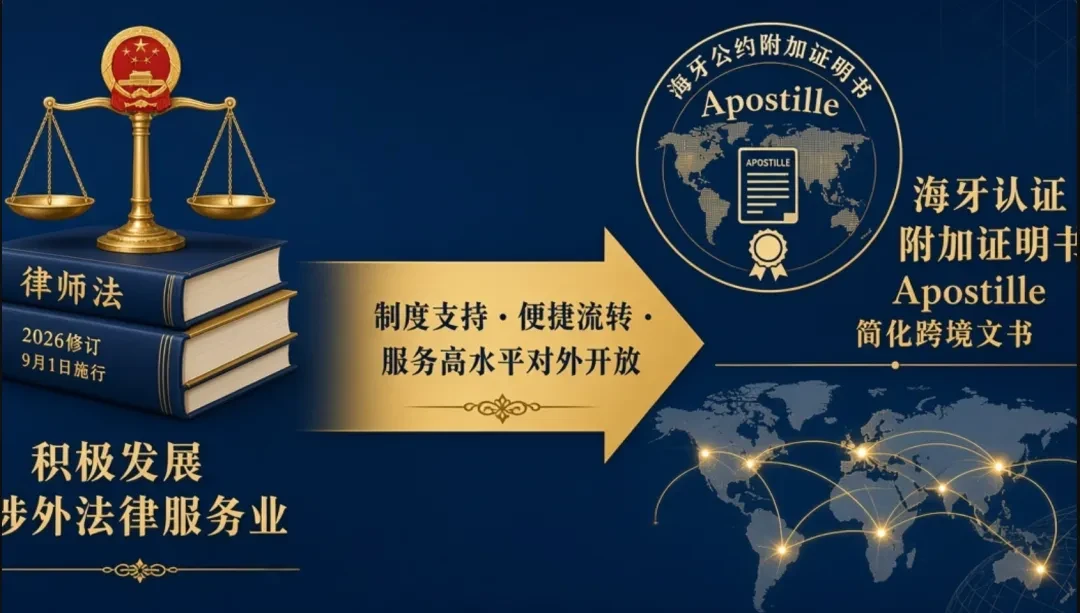
How Notarization and Authentication Agencies Support China's High-Level Opening-Up
Seize the momentum, safeguard your global expansion
How International Notary and Authentication Agencies Support China's High-Level Opening-Up
2026-9-1Newly Revised Lawyers Law Takes Effect: A New Chapter for Cross-Border Legal Services
On 2026 year 8 month 28 day, the 24th meeting of the Standing Committee of the 14th National People's Congress adopted the decision to amend the "Law of the People's Republic of China on Lawyers".Add Item 7The decision explicitly elevates the active development of foreign-related legal services to a statutory requirement.Effective as of 2026-9-1At the same time, the Hague Convention Abolishing the Requirement of Legalization for Foreign Public Documents has been in force in our country for nearly three years, significantly simplifying the process for foreign notarial documents to be used in China. As an international notary and authentication service provider, how can we proactively take action and deliver precise results? This article explores this question from three dimensions.
I. New Law Protection: The 2026 Amendment to the Lawyers Law Bolsters Foreign-Related Legal Services
This amendment to the Lawyers Law is a targeted "small-scale" revision, focusing on upholding and strengthening the Party's leadership over lawyers' work and advancing party building within the legal profession.Actively develop the international legal services industryRevisions to practices such as the Greater Bay Area lawyers' professional practice, though few in number, carry significant weight.
📜 Article 7 of the New Lawyers Law (Full Text)
The state actively develops the foreign-related legal services industry, strengthens the cultivation of foreign-related legal talent, supports law firms in enhancing their capacity to provide foreign-related legal services, encourages international exchange and cooperation within the legal profession, safeguards the legitimate rights and interests of clients, and serves high-quality development and high-level opening up.
Decision of the Standing Committee of the National People's Congress on Amending the Lawyers Law of the People's Republic of China
This provision is of exceptional significance. During the legislative amendment process, it was suggested that actively developing international legal services would better protect the legitimate rights and interests of parties involved, and recommended adding relevant provisions to this article. The final adopted article explicitly includesProtect the legitimate rights and interests of clientsThis provision reflects the legislature's emphasis on legal services for foreign-related matters.People-centeredvalue orientation.
🔹 Three Key Highlights of the Legal Amendment
Strengthen institutional supply:
The revised Lawyers Law has strengthened institutional support to safeguard the quality improvement and efficiency enhancement of cross-border legal services. Cross-border legal services have been elevated from policy advocacy toLegal system safeguardsprovides a solid legal basis for industry development.
Clarify talent development objectives:
Strengthening the cultivation of lawyers specializing in foreign-related affairs has been codified into law, enabling collaborative training among universities, bar associations, and legal service institutions.Legally savvy, fluent in foreign languages, and an expert in your field.provides direction for cultivating international legal talent.
Institutionalizing Mainland Practice for Hong Kong and Macau Lawyers
The new law explicitly permits qualified Hong Kong and Macau lawyers to practice in nine cities of the Greater Bay Area on the mainland. This will help address gaps in legal services related to Hong Kong and Macau while better meeting the needs of mainland enterprises seeking various cross-border legal support as they expand globally. The decision elevates what was previously a six-year pilot policy into formal legislation.
For international notarization and authentication agencies, the implementation of the new law meansDemand for cross-border legal services is expected to surge again.Whether it's the need for document notarization and legalization as Chinese enterprises go global, or the legal document circulation requirements for foreign companies entering China, demand will surge significantly. We should seize this institutional dividend.Proactively enhance service capabilitiesEfficient and professional notarization and authentication support for cross-border lawyers and enterprises.
II. Mutual Efforts: The New Landscape of Foreign Notarization and Authentication for Use Within China
In the past, using foreign notarized documents in China often required a lengthy "double authentication" process: first obtaining notarization and consular legalization in the country of origin, followed by further authentication at the Chinese embassy or consulate there. This process could take weeks or even months. WithThe Hague Apostille Convention entered into force in our country on 2023-11-7.This situation has undergone a fundamental change.
🌐 Core Community Rules
Notarized documents from a State Party to the Convention intended for use in mainland China,Only the Apostille for Convention Countries is required.No consular legalization by our embassy or consulate in the local area is required. Documents with an attached Apostille can be used freely between countries party to the Convention.
Notice from the Ministry of Foreign Affairs and the State Administration for Market Regulation
Currently, 127 states are parties to the Convention. For documents from non-party states used in mainland China, consular authentication must first be obtained from the competent local authority, followed by consular authentication at the Chinese embassy or consulate in that location.
🔹 Domestic Case Studies: Efficient Application of Foreign Notarization and Authentication in China
🏛️ Case 1: Foreign Nationals Register Real Estate with Hague Apostille Certification (Huzhou)
In 2024, Ms. Zhang, a Singaporean citizen, completed real estate registration at the Huzhou Real Estate Registration Center. Previously, foreigners had to obtain notarized powers of attorney through a "double-verification" process, which typically took20 business days..., cumbersome processes, and high costs. In this case, Ms. Zhang needed only a foreign-related notarial document with an attached "Apostille".Less than half an hourThe registration process was completed. This marks the first real estate registration for a foreign national with an additional certification in Huzhou City after the Convention entered into force.
💡 Insight: Foreign notarial documents with an Apostille can be directly used in China for administrative matters such as real estate and business registration, improving efficiency by over 90%.
⚖️ Case 2: Recognition of Foreign Divorce Judgment in Chinese Court (Chengdu)
In 2023, Chinese citizen Wen applied to the Intermediate People's Court of Chengdu for recognition of a divorce judgment issued by a court in California, United States, and submitted the foreign judgment along with an apostille. The court held that the Convention on the Elimination of Foreign Public Documents' Requirement of Authentication entered into force in China on 2023 year 11 month 7, and therefore applies to this case. The public document submitted by Wen was issued in another contracting party to the Convention, the United States, and has been issued with an apostille.Exempt from authentication proceduresand confirm the authenticity of the relevant signatures and seals. Upon review, the court rulesRecognize this U.S. divorce judgment。
📌 This is after the Convention entered into force in our countryFirst application in a judicial caseIt fully demonstrates China's judicial commitment to fulfilling its obligations under international conventions.
🏢 Case 3: Simplified Registration for Foreign-Invested Enterprises (National)
The State Administration for Market Regulation has issued a dedicated notice requiring the implementation of the Convention in registration and administration. In accordance with the Convention, notarized documents from contracting states intended for use in mainland China require only an Apostille from the issuing country. This streamlines processes such as establishment and registration changes for foreign-invested enterprises operating in China.Significantly reduces document processing costs and time.。
These cases clearly demonstrate thatThe channel for foreign notarization and authentication to be used within China is now open and increasingly efficient.As an international notary and authentication service provider, we not only master the processes for exporting Chinese notarial documents but also...Expertise in regulations governing the entry of foreign notarized documents into Chinaproviding services to domestic and international enterprises and individualsTwo-way, end-to-endNotarization and authentication services.
III. Proactive Engagement: Three Key Focus Areas for International Notary and Authentication Agencies
Against the dual backdrop of the new "Lawyers Law" taking effect and the deepening application of the Hague Convention, Gongshitong—as an international notary and authentication service provider—should focus on the following three dimensions:
Focus Area 1: Build a "Two-Way One-Stop" Notarization and Authentication Service System
Serve Chinese enterprises "going global" by offering integrated services for "foreign-related notarization + Apostille/Consular Legalization"; and support foreign enterprises "coming in" by...Assist in reviewing and identifying foreign apostillesHelp domestic users quickly verify the authenticity of foreign notarized documents. EstablishedClassification and processing mechanism for documents from contracting and non-contracting statesProvide precise "menu-style" services to meet the needs of different customers.
Focus Area 2: Deepen Collaboration and Empowerment with International Lawyers
The new Lawyers Law explicitly strengthens the cultivation of foreign-related legal talent and supports law firms in enhancing their cross-border service capabilities. Notary and authentication institutions should proactively engage with foreign-related law firms to establish a normalized collaboration mechanism for cross-border investment, international arbitration, overseas intellectual property rights protection, and more.Recognition and Enforcement of Foreign JudgmentsIn such scenarios, notarial authentication is the foundation, while legal representation is an extension.Combining both provides complete legal protection.Co-develop cross-border legal services for enterprises and individuals, enabling mutual empowerment between notary and lawyer services.
Focus Area 3: Seize the Opportunities of Digitalization and Global Alignment
Leveraging digital tools promoted by the Ministry of Justice, such as overseas remote video notarization, to provide contactless and efficient notarization and authentication services for Chinese citizens living abroad. Additionally,Train versatile professionals proficient in the Hague Convention and notary authentication regulations across countries.Enhance the institution's professional authority in international notarization and authentication. The Chongqing-Sichuan Free Trade Zone courts have already launched user-friendly measures such as online video witnessing for mandates to reduce litigation burdens on parties—notarization and authentication institutions should actively align with these innovative practices.
Conclusion
On 2026-9-1, the newly revised Lawyers Law came into effect. The nation has sounded the call to actively develop foreign-related legal services and strengthen the training of foreign-related legal professionals. The deepening application of the Convention Abolishing Legalization for Foreign Public Documents now makesStreamlined and efficient bidirectional translation between Chinese and English。
As an international notary and authentication service provider,We are not only authenticators of legal documents, but also guardians of Chinese enterprises going global, service providers for foreign companies entering China, and active participants in international legal exchange.By building a two-way, one-stop service system, deepening collaboration with international lawyers, and seizing opportunities to align digitally with global standards, we are certain to find our place in this era of change and provideSafeguarding the legitimate rights and interests of clients, serving high-quality development, and advancing high-level opening up.Contribute essential "proof" energy.
📎 Reference
Decision of the Standing Committee of the National People's Congress on Amending the Lawyers Law of the People's Republic of China (Adopted at the 24th Meeting of the 14th Standing Committee of the National People's Congress on 2026 Month 8, 28); Relevant announcements and interpretations from Xinhua News Agency, the Ministry of Justice, the Ministry of Foreign Affairs, etc.
* This article is based on publicly available laws, regulations, and news reports for industry reference only.