
2026-2027 Major Changes to the Hague Apostille Convention: Vietnam, Thailand, and Algeria Join — See the Complete List of Contracting Parties at a Glance
Gongshi Tong · Global Notarization & Authentication
2026-2027 Major Changes to Hague Apostille!
Vietnam, Thailand, and Algeria join: View the full list of contracting parties at a glance
The Apostille Convention continues to expand, making cross-border document processing faster and more cost-effective.
Many friends have recently asked: Has the Hague Convention added new member countries?
Do I still need to visit the embassy to process documents for Vietnam or Thailand?
Answer:Yes, and the changes have been significant.
From 2026 to 2027, the Convention on the Abolition of Legalization for Foreign Public Documents (commonly known as the Hague Apostille Convention) will welcome a significant new member. This is a tangible benefit for Chinese citizens studying abroad, working overseas, immigrating, or conducting cross-border business.
1. What is an Apostille?
Previously, using Chinese official documents abroad required a three-step process: notarization, authentication by the Ministry of Foreign Affairs, and consular legalization. This was time-consuming and costly. After joining the Hague Convention, only one step is now needed.ApostilleThe other contracting state recognizes it directly, significantly simplifying the process.
Notarize→Ministry of Foreign Affairs Certification→Consular Authentication⇒Notarization → Apostille
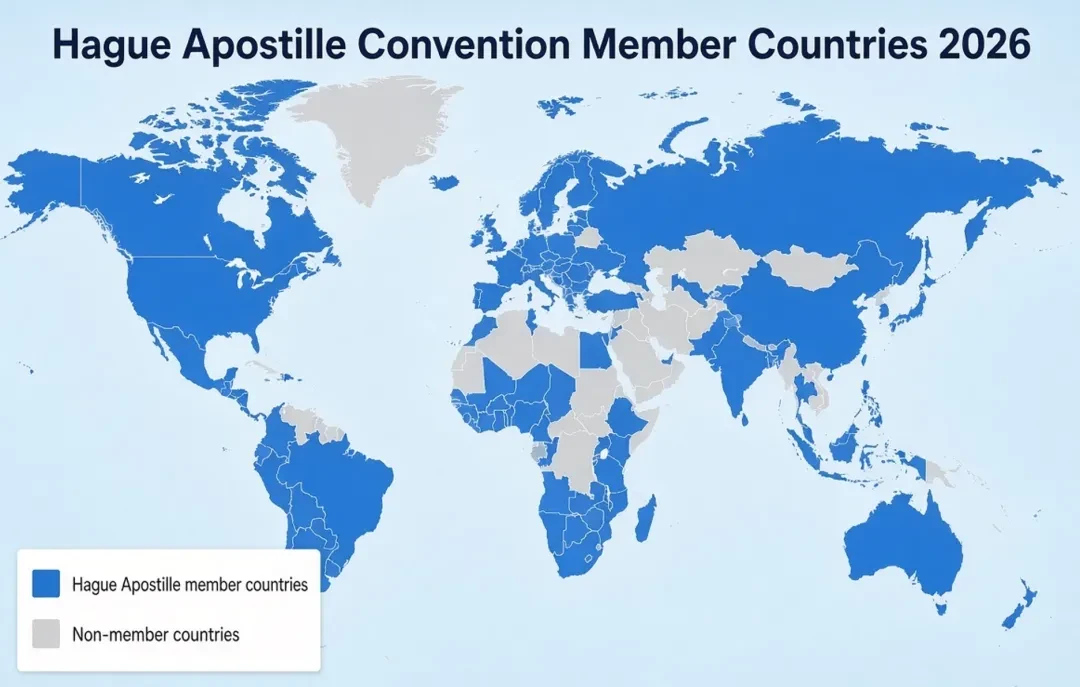
China has already2023-11-7Officially effective. Currently, there are approximately130 Parties。
II. Key New Members 2026-2027
🇩🇿
Algeria
Effective on 2026/7/9
🇻🇳
Vietnam
Effective on 2026/9/11
🇹🇭
Thailand
Effective on 2027/2/28
From the date above, public documents between China and these countries may, in principle, use Apostille certification directly.Except where individual countries raise objections)。
III. Complete List of Contracting Parties (Organized by Region)
The following list, compiled based on information from the Hague Conference on Private International Law (HCCH) and other authoritative sources, includes countries that have joined or are about to join (including mainland China, Hong Kong SAR, and Macau SAR).For the latest updates, please refer to the HCCH official website.
🌏
Asia
25
China (including Hong Kong and Macau)Armenia, Azerbaijan, Bahrain, Brunei, Georgia, India, Indonesia, Israel, Japan, Kazakhstan, Kyrgyzstan, Mongolia, Oman, Pakistan, Philippines, South Korea, Saudi Arabia, Singapore, Tajikistan, Turkey, Uzbekistan, BangladeshVietnam (effective 2026/9/11) Thailand (effective 2027/2/28)
🌍
Africa
17
Botswana, Burundi, Cape Verde, Eswatini, Lesotho, Liberia, Malawi, Mauritius, Morocco, Namibia, Rwanda, Sao Tome and Principe, Senegal, Seychelles, South Africa, TunisiaAlgeria (effective 2026-7-9)
🌍
Europe
45
Albania Andorra Austria Belarus Belgium Bosnia and Herzegovina Bulgaria Croatia Cyprus Czech Republic Denmark Estonia Finland France Germany Greece Hungary Iceland Ireland Italy Latvia Liechtenstein Lithuania Luxembourg Malta Monaco Montenegro Netherlands North Macedonia Norway Poland Portugal Moldova Romania Russia San Marino Serbia Slovakia Slovenia Spain Sweden Switzerland Ukraine United Kingdom
🌎
Americas
34
United States Canada Mexico Antigua and Barbuda Argentina Bahamas Barbados Belize Bolivia Brazil Chile Colombia Costa Rica Dominica Dominican Republic Ecuador El Salvador Grenada Guatemala Guyana Honduras Jamaica Nicaragua Panama Paraguay Peru Saint Kitts and Nevis Saint Lucia Saint Vincent and the Grenadines Suriname Trinidad and Tobago Uruguay Venezuela
🌏
Oceania
7
Australia, New Zealand, Fiji, Samoa, Cook Islands, Marshall Islands, Niue, and others
4. Practical Tips
Documents must still be processed through the traditional consular double authentication before the new country officially takes effect.
Even if both countries are parties, it may not apply due to objections (e.g., currently)Not applicable between China and India.)。
The process generally follows these steps:Notarization → Obtain an Apostille from the local Foreign Affairs Office or a ministry-authorized agency。
Requirements may vary slightly by document type (e.g., academic credentials, birth certificates, corporate documents, powers of attorney). Please verify in advance.
Special Notice:For Vietnam, Thailand, and Algeria, official documents must still go through the traditional consular legalization process before the effective date. Please plan accordingly to avoid delays in travel or business arrangements.
Final Thoughts
The scope of Hague Apostille certification continues to expand, making cross-border document processing increasingly convenient.
If you have recentlyVietnam, ThailandRelated requests or followAlgeriaNew members: Review the updated rules early to avoid detours.
For the complete and latest list, pleaseHCCH Status Tableas a standard.
Please leave a comment below if you need to confirm specific countries or file types.
Follow us for the latest updates on international certifications.
This information is compiled from the Hague Conference on Private International Law (HCCH) and other authoritative sources for reference only. For specific procedures, please refer to the latest official announcements.
Apostille Convention · Convention Abolishing the Requirement of Legalisation for Foreign Public Documents